Connect with us today for a free estimate or information to better your life with window film.
Schedule an appointment for a free on site estimate for your home or office. Check vehicle prices, book an appointment or maybe buy a gift card for someone special.
Book a Free Estimate
Vehicle Pricing & Booking
Gift Cards
Reduce Health Risks
Window film can reject up to 99.9% of UV Rays (Ultra Violet light) to reduce the sun’s adverse effects on your skin. UV light can cause or aggravate skin cancers, signs of premature aging, including dark spots and wrinkles and window film is recommended by the Skin Cancer Foundation.
Cut the Heat
Certain Window films reduce Infrared light, the most amount of damaging heat without losing visible light. Window Tinting lowers the visible light, reducing the amount of heat that shines through your windows. Infrared or IR is invisible light that accounts for about half of the heat you feel coming from the sun. IR coated or ceramic films help reduce 50% or more of the heat from Infrared light with an very light shade of film. The other 48% comes from visible light and the film has to be dark and reflective to achieve similar heat reduction over the Infrared rejection films.
Eye Strain & Glare Reduction
Window tinting can block visible light to reduce glare and eye strain. Reducing visible light can help with eye strain or glare from direct or reflected light just like sunglasses for your car, home or office.
Save on energy costs $$$
Window tinting can lower your energy costs up to 30%, with a return on your investment and saving money for years to come. If your house or office faces the east, south or west, you definitely need window film. With a variety of films to choose from, we can get you the right film for your needs and save you hundreds a years in energy costs.
Increase Safety & Security
Window films can increase protection from flying glass shards or smash and grab crime. Glass breakage can be deadly. Most window films can help protect you, your car, home or busines by holding the broken glass in place or keep shards of broken glass together. Security films can reduce theft in retail locations and be completely clear in appearance.
Window Films & Window Tinting for Home and Office
We offer solar control window films, decorative and privacy films, security film and anti-graffiti films for home, office, retail and store front applications.
There are wide range of window films, varying in darkness, reflectivity, opacity, and texture. Depending on what your needs are, we may have a solution with window film. Here are a few quick links to view some general options of window tinting for home or office.
How much protection can you have with a virtually invisible layer between you and the sun?
Well, a lot. UV Protection, Heat Rejection, Glare Reduction, Privacy and more. Since the mid nineteen-sixties window film has come a long way with an ever evolving technology. Nowadays, you can get more visible light without most of the problems that come along with sun light. New Infrared light coatings, selective light wave polyesters can reduce a tremendous amount of heat with an almost clear film.
Benefits of window tinting your home or office vary depending on what you’re trying to achieve.
UV Protection
Solar Control Window Tinting helps to manage heat, glare and prolongs the fading process by blocking UV rays. UV light causes fading to fabrics and furnishings but visible light and heat are also part of the fading process. Unless you plan on living in a cave, where no sunlight can reach, options are limited. With that, always consider what will be affected by the sun, to determine the correct film for the job.
Take for instance, fading of fabrics, furnishings, or artwork. Most materials have varying rates of fading, depending on what they’re made of or their colorfastness. These are two key accelerators of fading. Wood furniture or floors can be greatly impacted by sunlight if not protected properly. Window film helps prolong the process of fading, but it does not stop it. There are more options available for wood, such as UV resistant waxes or other coatings that can help reduce fading. As for colorfastness, plastics, paper, cloth, and other materials that are dyed or pigmented, will have wide ranging rates when exposed to sunlight. Each one will be different depending on what it’s made of and how the color is produced. The average rate with window film is 2 to 5 times greater than the normal rate of fading would be depending on the material, color and exposure to sunlight.
Glare Reduction
Although it’s nice to have natural light filling the space, sometimes it’s too much. Window tinting films can block from 10% up to 98% of the light coming through the windows. Glare from too much light or reflected light can create problems even when the sun isn’t shining through the window directly. Bright spots in your space can be annoying at times creating a nuisance or less comfortable environment. Prolonged exposure to intense visible light can cause eye strain leading to fatigue and headaches, another reason when determining what works best for your situation.
Heat Rejection
Hot spots are the best reason for window film. Window tinting can reduce up to 88% of the heat from direct sunlight. Although 88% heat rejection sounds great, that particular film is extremely dark and silver or mirrored. When it comes to heat rejection, there is a wide variety and darknesses of films, depending on what you are trying to achieve. Each film will vary in darkness and heat rejection. There are virtually invisible films that block 50% of the heat from direct sunlight. Window film technology has greatly evolved with heat rejection. New infrared coatings, spectrally selective polyesters and traditional metallized films have all gained features over the past 20 years. Heat rejection being the biggest leap forward and probably the best benefit of window film.
Privacy
Although this may not be a determining factor in your overall reason to use window tinting, some films provide daytime privacy. The darker reflective films, decrease visibility from outside of the building or residence, but mostly just during the day. It is a misconception that darkening a window will give you privacy at night time. Unfortunately that’s not the case. Although it does reduce visibility, being darker, it does not obscure the view in. It is simply from wherever the greater light source is. When it’s dark outside and your lights on inside, the window film is only reducing visibility with the darkness of the film. If you have blinds or shades, then you have your privacy and do not need to go dark with the film. If you were looking for something decorative or for absolute privacy, we have other options here.
Window Film Removal
Need your tint removed? We do that! For the most part, the film portion of window tinting can be fairly easy to remove. Depending on age, its the glue that will get you. We have a few techniques for removal. These including steaming the film off or manually scrapping the glue and film off with a razor or scrubby pad. Both options are time consuming and labor intensive.
We do our best to not damage any glass during the process. Unfortunately, there is always a chance for scratches or marring. This can happen pulling the film or if a razor balde is used for removal and sometimes manufactering flaws. We do not guarantee and will not be responsible for damage to glass during the removal process.
* Not every solar control film available is shown, we use a variety of window film manufacturers and certain restrictions apply to every film based on the window glass type, location and condition. Window Film Manufacturers Warranty for interior films if applicable are limited lifetime residential and up to 12 year commercial unless otherwise stated. Exterior Films can vary from 2 up to 10 years. No warranty is implied by purchase or installation.
Solar Control Window Films
Window Films offer solar control with heat rejection, glare control and UV protection from the sun.
Solar Control Window tinting has great benefits and features. Some of theses benefits are reducing glare and eye strain from unwanted or reflected light. It helps reduce fading of your interior furnishings, floors, fabrics, paintings and more by blocking UV rays. Solar Control Window Films help keep your energy costs down by lowering direct heat from the sun. Solar control window films can feature year round climate control by insulating the glass. Another feature is adding daytime privacy, depending on the reflectivity and darkness of the film. There are so many options, interior and exterior films, from clear to tinted, we have a window film for everyone!
Solar Control Window Films – Exterior Films, IR Spectrally Selective Films and Dual Reflective Films
The latest in window film technology offers a great solution for numerous issues inside and outside.
Virtually invisible, this new and unique window film offers protection for Artificial Turf, Vinyl Siding and reduces heat from the outside of your windows. This 80% window film can reduce up to 50% of the heat, 23% of the glare and 99% of the UV Rays.
Here is an example of exterior 80% window film showing a slight blueish green hue on the top pane and no film on the bottom pane.
Another example of exterior 80% window film showing how much light is reduced with the exterior 80% (top right no film, bottom left with film)
70% - Barely noticeable, this window virtually clear film can reduce up to 46% of the heat, 30% of the glare and 99% of the UV Rays.
50% - As a medium darkness films, this window film can reduce up to 55% of the heat, 45% of the glare and 99% of the UV Rays.
35% - Dark but not to dark, this window film can reduce up to 53% of the heat, 55% of the glare and 99% of the UV Rays.
25% - The medium darker shade, this window film can reduce up to 62% of the heat, 64% of the glare and 99% of the UV Rays.
15% - Really dark for those trouble spots, this window film can reduce up to 82% of the heat, 89% of the glare and 99% of the UV Rays.
Dual Reflective Window Films Exterior View
This image shows the exterior of traditional reflective films and how the darker films are more reflective like a mirror.
There is also a 2% and 5% film available. These films are used for one way mirror and visible privacy for securing areas out of plain sight. Certain interior lighting restrictions would apply for best results in visibility reduction.
*Pricing is based on ground level work. Equipment such as ladders, lifts or scaffolding will increase the cost depending on the difficulty of the installation.
Decorative & Privacy Films
Decorative and Privacy films are used by interior designers and decorators to add texture, color, and depth to any space.
When it comes to decorative film or privacy film, there is a wide range of materials and patterns. These include frosted, textured, colored, and printed. Achieve your style in your space, with a decorative film to bring it to life.
Unique Privacy Designs
Frosted, Textured, Colored or Custom Printed for your space.
Make your space pop with an etched frost design, a faux stained glass or custom printed designs.
Etched or frost films come in varying opacity or densities and reveal different shades of light and shadow. For more a heavier opacity privacy film may be require depending on your needs. Commonly used in designs for bathrooms or for separation in office spaces. Conference rooms and meeting rooms are prime examples. Glass walls that need some kind of distractor for both occupants inside and outside. Furthermore, as a distractor keeping people from running into glass walls which by code is required.
Frosted decorative films can be layered or stacked and cut to just about any type of design. This is also true with some of the fabrics and heavy textures that are available also. Some of these frost films come in gradients and patterns, to achieve a different look.
Textured films can obscure or distort like a baroque or glue chip style glass. Make glass look antique or seeded or even like water glass. With so many to choose from it might be hard to make a final decision.
Security & Anti-Graffiti Films
...
coming soon…
Measuring your windows for window film.
Easy instructions for getting the correct measurements for any window when applying window tinting film.
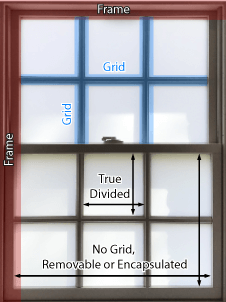
How to measure the real size of the glass panes for an accurate quote. If you have a tape measure go and get it. You will also need a way to record the amount of panes and their measurements. Most windows are comprised of a frame and glass pane. Sometimes there are dividers or grids in or on the glass panes.
The picture shows a sinlge hung window with an upper and lower pane of glass for illustrating diffenrent window types.
The grid that divides up the window can be removable, encapsulated in the pane or True Divided (non removable). With no grid, encapsulated grid or removable grid you can measure the glass pane from frame to frame. For True Divided or non removable grids, you will have to measure each individual pane of glass. It’s tedious but necessary.
First thing to do is measure the height and width of each glass pane. You do not need the overall window and frame, when measuring your windows for window film. Window film only goes on the glass and not the frame. Don’t assume that all windows will be the same size, measure each pane to be absolutely sure. Even if they look close in size you should still double check and avoid mistakes.
For arched, circular or odd shaped window panes it gets tricky. Measure the width at the widest point and the height at the tallest point, usually the center of the pane. For triangle or trapezoid windows measure the width at its widest point and the height at it’s tallest point. If there are some irregular shaped windows send us a picture if you’re not sure and we will be glad to help.
Choose the Best Automotive Window Tinting Film for Your Vehicle.
Ride in Style and Comfort with Automotive Window Tinting!
Do you like the light subtle look or a dark eye catching black? We offer a range of films varying in darkness for your vehicle. From the lightest to the darkest these films give you options on glare reduction, UV protection and heat rejection along with great looks! All of our window tinting films provide 99% UV Ray (Ultra Violet light) protection from the sun, reducing glare, fading and skin complications from the sunlight.
Vehicle window tinting, protecting you and your investment.
Most people don’t even think about how damaging the sun can be. But, when you’re at the beach or outdoor festival and feel the effects of the sun, you use a sun screen. Well, window tinting films are just that, a sun screen for you inside your car. It’s like wearing a 1000 SPF sun screen blocking harmful ultraviolet (UVA) rays. These contribute to premature aging and skin cancer! Not only does it protect you, it also protects your vehicle from damage caused by fading, heat and glare.
Yes, window film can reduce heat, but here are a few things to keep in mind. There is no window film that can reduce radiant heat, there has to be air moving behind it. So, when your car is sitting out in the sun, it will still get hot inside. Just not as hot with window film.
The idea behind it is that the movement of air on the interior will reduce the build up of heat. Lowering the window slightly or having side window deflectors to allow for air movement can make a big difference in how much heat will build up inside the vehicle.
At certain times, glare and reflected sun light can be really annoying or blindingly dangerous. Darker shades of window film can cut the glare. Improve your view of the road and surroundings, increasing your visibility to travel as safely as possible year round.
In a nut shell it’s not dark. NC DOT requires a “Net Transmission” film allowing up to 32% to pass thru the window.
Wow, that sounds pretty dark, unfortunately it’s not. This is a medium shade of window film and looks great on most vehicles. Now there are a few exceptions. Trucks, vans and SUV’s can have a darker or blacked out windows behind the driver. The front door windows must comply with the NCGS 20-127 code.
All “cars” (coupe or sedan) are required to have the same tint/film on all side and back windows. There is, for those who need it, a medical exemption for a darker film. This is a lengthy process and not everyone will get it. Consult your optometrist or dermatologist for recommendations on how to get the medical exemption.
SunTek CXP Window Film
The best window tinting option at a great price.
We offer SunTek CXP. This carbon IR coated hybrid film with great heat rejection for everyone at the same price as a carbon film at most other tint shops! This window film gives you comparable heat rejection of a more expensive “ceramic” film with the great look of carbon film. No more guessing if it’s the right film for you and your vehicle.
If it’s your side or back windows or the windshield we have the best option at a great price! These auto glass tinting films cut the glare, reducing eye strain from the sun, slows the process of the sun’s UV Rays from fading of your vehicles interior and best of all these window tinting options keep you cool from the blistering sun’s heat!
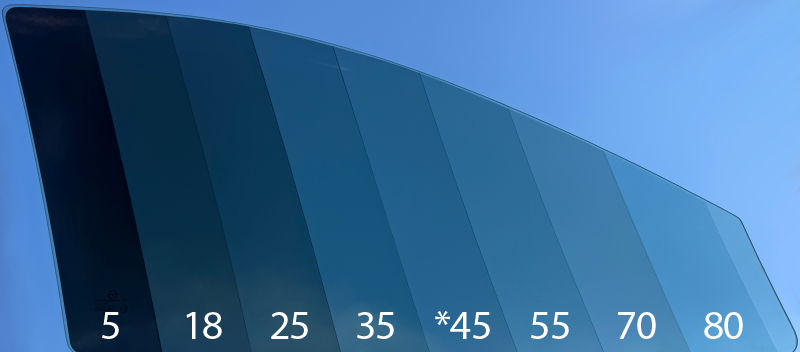
80% – virtually invisible
This film rejects 40% of the total heat that comes through the window and complies with most state laws for windshields.
Visible Light Transmitance VLT 75%
Infrared IR rejection 52%
Selective IR Rejection 74%.
70% – almost unnoticeable
This film rejects 44% of the total heat that comes through the window.
**This film complies with most state laws for windshields with Medical Exemptions
Visible Light Transmitance VLT 63%
Infrared IR rejection 56%
Selective IR Rejection 79%.
55% – North Carolina “Legal” shade of tint/film
This film rejects 42% of the total heat that comes through the window. This film complies with the NCGS 20-127 and is legal on all side and back windows of passenger cars and the front doors of Trucks, Vans and SUVs.
Visible Light Transmitance VLT 54%
Infrared IR rejection 47%
Selective IR Rejection 66%.
45% – North Carolina “Legal” shade of tint/film
This film rejects 50% of the total heat that comes through the window. This film complies with the NCGS 20-127 and is legal on all side and back windows of passenger cars and the front doors of Trucks, Vans and SUVs.
Visible Light Transmitance VLT 41%
Infrared IR rejection 54%
Selective IR Rejection 76%.
35% – This film matches most new factory tinted glass
This film rejects 53% of the total heat that comes through the window. This film complies with the NCGS 20-127 for rear side and back windows of Trucks, Vans and SUVs behind the front driver and passenger doors.
**This film also complies with most medical exemptions for the sides and back of passenger vehicles, front doors of Trucks, Vans and SUVs.
Visible Light Transmitance VLT 33%
Infrared IR rejection 55%
Selective IR Rejection 79%.
25% – This film matches most factory tinted glass
This film rejects 52% of the total heat that comes through the window. This film complies with the NCGS 20-127 for rear side and back windows of Trucks, Vans and SUVs behind the front driver and passenger doors.
**This film also complies with most medical exemptions for the sides and back of passenger vehicles, front doors of Trucks, Vans and SUVs.
Visible Light Transmitance VLT 23%
Infrared IR rejection 49%
Selective IR Rejection 70%.
18% – This film matches slightly darker factory tinted glass
This film rejects 55% of the total heat that comes through the window. This film complies with the NCGS 20-127 for rear side and back windows of Trucks, Vans and SUVs behind the front driver and passenger doors.
Visible Light Transmitance VLT 17%
Infrared IR rejection 52%
Selective IR Rejection 73%.
05% – This film is really dark and extremely hard to see through at night
This film rejects 60% of the total heat that comes through the window. This film complies with the NCGS 20-127 for rear side and back windows of Trucks, Vans and SUVs behind the front driver and passenger doors.
Visible Light Transmitance VLT 5%
Infrared IR rejection 54%
Selective IR Rejection 77%.
Window Film Removal
Need your tint removed? We do that! Mostly, the film portion of window tinting is fairly easy to remove. Depending on age, it’s the glue that will get you. We have a few techniques for removal. These including steaming the film off or manually scrapping the glue and film off with a razor or scrubby pad. Both options are labor intensive.
Removing Window Tint or Window Film
When window tint goes bad…
Removing window tint or window film can be a very tedious task.
There are lots of reasons for removing window tint or window film. Safety would probably be the first one when it comes to automotive window tinting. Aesthetics would probably be second with automotive, residential and commercial window tinting removal. Nobody wants it to look bad.
Removing window tint that has bubbled up on the back glass or rear windshield because of adhesive failure.
The most common reasons for window tint removal.
Adhesive failure, fading or change of color, delaminating and flaking are common problems when tint goes bad. We also remove window tint for state inspection. Depending on the type of tint and how long it has been on the window may make a big difference in how window tint is removed. Removal options are based on the condition of the film, some work better depending on the situation. Whether it’s a vehicle, your home or your business, one or more of these options may work for you. Some scenarios, like a tint that’s too dark or too light, bubbling, wavy or distorted film and accidental damage are reasons when window tint should be removed.
The most common issue with window tint is adhesive failure.
The telltale signs are tint bubbling, peeling, wavy or rippled appearance, distortion or speckling. This tends to be a moderate to hard removal. The type of installation, whether it’s residential commercial or automotive maybe different in removal. Also there are a couple of different types of adhesives from different manufacturers of window film.
The majority of window tint uses a pressure sensitive adhesive another type is called CDF. The CDF adhesive is a dry adhesive that is activated with water. These films are mainly for commercial and residential installations. The problem is during removal of this window film, basically it bonds to the glass chemically. So when removing it, it can be extremely difficult and may require solvents to remove the adhesive.
What is delaminating and flaking window tint?
Delaminating and flaking sometimes occur during the lifespan of window films. Delaminating can show up as a wavy or distorted look or peeling away from the window. Flaking occurs when the hardcoat has gone bad. This results in small or very tiny speckles throughout the window film and rubs off onto to whatever touches the tint. Both of these issues can make removal a complete mess. The film can break off in little tiny pieces, ultimately resulting in having to scrape the window while it is wet. These issues can be hazardous to your health when removing the tint. Using a facemask, gloves and protective coverings on your clothes, will reduce the chance of any particles sticking to your skin getting in your eyes or lungs. You probably need to call a professional.
How to remove window tint.
The pull and scrape option.
The least desired, and most cumbersome of labor for window film removal. This process, involves labor and lots of it. Basically, if you can get the film to come off by pulling it off, what will remain is just the adhesive. The adhesive, depending on which type, pressure sensitive or CDF, maybe soaked with a water and soap solution or for CDF film a solvent. I do not recommended doing either if these in direct sunlight if possible. If you’re lucky and the adhesive fogs up, it’s ready to be scraped. Scraping the adhesive off requires either a stainless steel razor blade, white scrubby pads, #000 steel wool or plastic razor. This technique may require more than one time cleaning the glue off the window. This is a messy process and the adhesive may stick to anything it touches like chewing gum, so be careful.
The Steaming option.
I would recommend using a steamer 99% of the time to remove window film. Prep your area for a lot of water, steamers tend to spit water during the film removal. Focus the steamer at the corner of the film to promote release of the adhesive. After a few seconds, use a plastic pry tool to lift and pull back the corner of the film. Carefully and slowly pull back on the film as you steam the window in a back-and-forth pattern across the area that you are pulling on. Most of the time this gets the film and the glue off but may leave some spots that you’ll need to use a white scrubby or #000 steel wool. Steel wool can be very messy itself so be very careful with it.
The Sweating option.
Sweating the film off requires water and a black plastic bag or clear plastic sheet. It works kinda like the steaming process, but takes a little longer. First soak the window down and then immediately cover with the plastic bag or sheet to trap the water against the film. This process takes longer due to the fact that it has to sit for anywhere between 10 to 30 minutes to penetrate the window film. This removal option is best in direct sunlight to promote the sweating process. Once you feel, it’s been on there long enough, try and test it by peeling up the corner. These techniques are very useful for vehicles with defrosters or antennas that are bonded to the rear window.
if it all seems too overwhelming, contact us if we’re in your area or find a professional near you. This can be more of a headache than most people imagine and may not be worth the effort. Cheap usually comes out expensive, so weigh your options and talk to a professional about removing window tint before its too late.
Unfortunately, there is always a chance for scratches or broken defroster/defogger lines (back glass). This can happen pulling the film off or if a razor blade is used for removal and sometimes manufactering flaws. With so many issues that can arise, we will not be responsible for damage during the removal process. Pricing can be as little as $15 for a door or side window. Full vehicles can cost $150+ for the removal and can take up to 2+ hours.
Automotive Window Tinting ~ Starting Prices
* General Tint pricing includes all side & back windows. Removal, Visor/Brow Strips or Full Windshields are not included. Options for single windows are listed under “Individual Parts” in the menu when scheduling online.
Automotive Paint Protection Film ~ PPF
Clearly Protected
Paint Protection Film (PPF) is a durable, high-grade, colorless urethane film, applied to high-impact areas of your vehicle.
The hood, bumper, mirrors and door edges – that take the brunt of damaging road debris. Automotive Paint Protection Films go by many names in the industry. Known as Clear Bra, Clear Mask, Invisible Shield, Clear Wrap, Rock Chip Protection and so on.
This virtually invisible barrier helps protect against flying road debris, abrasion, weathering and also resists yellowing in sunlight. If resale value is important to you, this is a great way to help keep the exterior looking like new.
The process starts with cleaning the vehicle. Next, prepare the surface by using a clay bar to remove the any contaminants in the clear coat. The installation uses distilled water and a very small amount of baby shampoo. This is for positioning the PPF, then using a squeegee to remove the solution for adhesion.
Once applied, PPF needs a few days to cure and a week before you can wash it. Synthetic waxes and PPF specific waxes are available to your vehicle paint clean, protected and looking new. *We do not recommend any Carnauba or any wax with kerosene or Naphtha.
Frequently asked questions – SunTek PPF
Can I wax SunTek Paint Protection Film Matte?
Some waxes will add a level of gloss to PPFMatte. However, there are waxes on the market specifically for matte finishes. Waxing is still recommended for added protection.
Can I take my car through a pressure wash with SunTek Paint Protection Film?
It is best practice to wait 3 days before washing your car. While hand washing is preferred, you can use a pressure wash, but be careful near edges as the pressure water can lift the edge.
Can “coatings” be applied to SunTek Paint Protection Film?
Ceramic coatings are approved for use with our Paint Protection Films when applied over the surface of the product. Ceramic coatings create an additional barrier for solvent and water penetration while not negatively impacting the performance or self-healing of our Paint Protection Film. This application will not void your warranty.
If there is a stain that won’t wash off, what do I do?
If a stain will not wash off with a regular car wash, you can apply isopropyl alcohol to a microfiber towel and clean the stain, if that does not work you can use a small amount of lacquer thinner. If the stain remains we would recommend you use a mild-abrasive wax and polish the surface of the film to restore the original appearance. Polishing/buffing of the film is a great way to remove contaminants from the surface, however this process should be limited to as-needed or once every 12- 18 months. An example of a mild-abrasive wax would be Turtle Wax Renew RX Polishing Compound Light to Medium Cleaner.
Premium Package XL (full bumper, full hood & fenders, rocker panels & mirror backs) $1250 – $2200 1-2 days
Full Vehicle (painted parts) $4500 – $7000 3-4 Days
*Prices are based on PPF Kit patterns for painted parts of the vehicle, custom work is additional
Automotive PPF Parts Prices
Full hood $500-$650 3-4 hrs
Partial hood (8-24″) $250 – $300 1-2 hrs
Full Roof $500-$850 4-5 hrs
Full Bumper $450 – $600 4-5 hrs
Full Fender (each) $150 – $250 3-4 hrs
Partial Fender $200 – $400 2-3 hrs
Trunk Ledge $50 each .5-1 hrs
Door Cup / Door Edge $15 each .5-1 hrs
Mirror Backs $30 – $50 each 1-2 hrs
*Prices are based on PPF Kit patterns for painted parts of the vehicle, custom work is additional.
Personal or Business Vehicle Wraps ~ Like Art in Motion
Custom Printed Wraps, Vehicle Graphics, Color Change Wraps, Reproduction Graphics and Stripes for Personal or Business Vehicles.
Everyone has their own style, show yours on your vehicle with custom vehicle wraps. Customize your vehicle, boat, RV or side by side.
We offer the installation and design of wraps and graphics. Custom graphics, reproduction stripes, business vehicle wraps and color change wraps.
There are a ridiculous amount of available colors, various finishes and textures to pick from.
Gloss: A shiny finish, some manufacturers offer high-gloss and chrome.
Satin: Just between gloss and matte
Matte: The opposite of gloss, a flat finish that accentuate a vehicle’s shape and also hides most defects.
Carbon Fiber: Carbon fiber wraps may have some texture to replicate real carbon fiber.
Color-Shift: These vinyls change color when viewed from different angles and in different lighting, making them unique vehicle wraps.
Personalize your vehicle with a new color without painting it. Here are just a few options for full wraps, skins or stripes.
The NEW 3M™ Wrap Film 2080 High Gloss finish features a brilliant mirror-like appearance. Take a look at the entire portfolio below. Which one are you choosing for your vehicle wrap?
3m 2080 Satin and Matte Wrap Film
3m 2080 Textures and Color Flips Wrap Film
3m 2080 High Gloss Wrap Film
3m 2080 Gloss Wrap Film
Avery Dennison™ Wrap Films have some unique options also. Ready to pick one? Maybe two for a one of a kind look?
There are way too many wrap manufacturers to list every single one. So if you find something you like, let us know, we will contact manufacturer and check for pricing and availability. 3M™ and Avery Dennison™ have both been in this business for a long time, over 100 years. We have had great success with other materials from various manufacturers over the years.
How long do vinyl wraps and graphics last? Keep in mind most wraps don’t last more than 3 to 5 years and that’s only if they’re well maintained. There are various “waxes” and “polish” products for gloss, satin and matte finishes for both vinyl wraps and paint protection wraps. Your horizontal surfaces like your hood the roof in your car the trunk lid those areas normally only have about a one year warranty since these areas are facing the sun they get the brunt of damage. Your hood usually goes bad first because it’s cooked from both sides. Heat from the sun and heat from the engine are like a double broiler on vinyl on your hood. The long and short of it, is that you should probably think about painting if you were looking for something long-term.
Custom printed wraps, decals or stripes are available in a wide variety of finishes and looks to achieve your needs. Contact us about pricing for wraps, graphics and stripes for your car, truck, van or suv. Vehicle wraps can be a great investment for personal and business.